
Up until now, I have used this blog as a platform to post my poems and short stories while I continue to work on my upcoming book, The Dreaded, taking place in the same universe as Swallowing Sands and Han Vs. Carpentier.
Today, however, I would like to write about something else entirely. Everyone who knows me knows that I am a diehard New York Giants fan and a sports fanatic in general. I’ll watch just about anything, whether it’s on the Ocho or not. That includes NASCAR, which I have been a fan of for as long as I can remember. I’m not sure how or why, but I specifically remember Dale Earnhardt Sr. exiting pit road during a race at Pocono in 2000 when I was no more than two years old.
Founded in 1948 on the beaches of Daytona, Florida, NASCAR has claimed to be North America’s premier racing league since the early 2000s. NASCAR is home to dozens of the best drivers, crew chiefs, and pit crews across the world, and they’re proud to showcase each and every one of them every week. While I’ll undoubtedly watch IndyCar, IMSA (International Motor Sports Association), or the Max Verstappen League—sorry, ‘Formula One,’— NASCAR has always been my favorite type of racing.
Whether it is the restrictor plate tracks of Daytona or Talladega, the short tracks of Martinsville or Bristol, or even some recent experiments with Atlanta Motor Speedway, COTA (Circuit of the Americas), and the Chicago Street Course, I’ve always appreciated the diverse schedules NASCAR has for their drivers. Even more so, I appreciate the skills of the drivers and their pit crews week in and week out as they tune their cars or rely on improvisation tactics during the race itself to try and reach the finish line first. Being a fan of racing takes a certain nuance and even patience. It can be hard to really get into and is boring or monotonous at times. NASCAR is no different, and it even has deeper challenges of its own.
You will have the typical ‘you can only turn left’ jokes mixed in with the Good Ole Boy stereotypes made worse by the fans’ hesitancy or, quite frankly, unwillingness to recognize the sport’s past behavior and shortcomings. However, the hurdles in front of NASCAR loom larger than a debate on whether it can be classified as a sport or even where its place is in a politically tumultuous country.
NASCAR feels like a shadow of its former self.
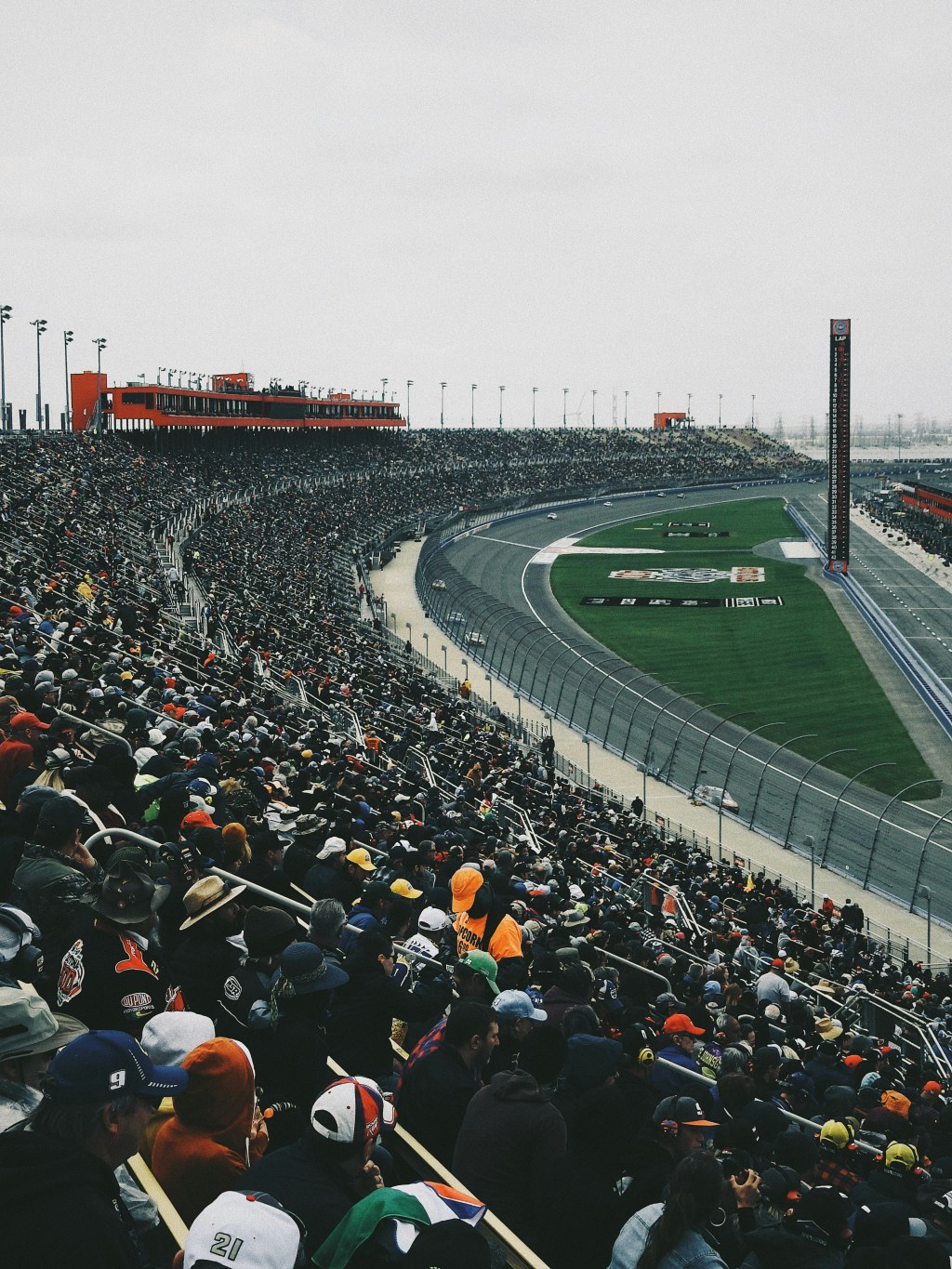
I’ve been a fan for over twenty years, but I have no problem admitting that. The Daytona 500 isn’t the spectacle it used to be. And it sometimes feels like the championship comes and goes with little fanfare. People may point to NASCAR’s inconsistency with their rule book; fans argue they can be lenient at times and strict on certain other rules. They also claim that today’s drivers have no personality and, thus, nothing for people to root for. NASCAR has even been accused of fabricating cautions for phantom debris so they can create a more exciting finish to a race. On TV, I see dozens, if not hundreds, of empty seats along the bleachers. I do not believe NASCAR is dying; I think people have lost interest—and there is a difference.
I remember back in the early to mid-2000s, you could walk into your local supermarket and spend no more than two minutes there before you came across a product that sponsored NASCAR. Never mind places like K-Mart, Walmart, or Target (all stores that have sponsored a team in NASCAR at one point or another), the cereal aisle was a who’s who of NASCAR brands vying for your attention. Meanwhile, there were countless other alcoholic beverages or energy drinks that had a stake in NASCAR lining the supermarket shelves—maybe a cardboard cutout of their drivers to go with it. Coke and Pepsi, Home Depot and Lowe’s, and UPS and FedEx all continued their respective rivalries on the track—everything from snacks and cell phone companies to restaurants and laundry detergent all had a place atop the hood of a car. You could not escape it.
It was in your face and constantly on your mind. And it was great! Every brand that sponsored NASCAR in those days brought with them their recognizable paint schemes. The cars would scream by every Sunday in a rainbow of familiar colors. Drivers became synonymous with their sponsors and vice versa. I cannot hear Jeff Gordon’s name without thinking of Dupont, nor can I think of Kyle Bush without thinking of M&M’s. But then something changed. The boom NASCAR had carried with it through the nineties into the mid-2000s faltered, and with it, the mass exodus of sponsors. Car owners and NASCAR executives got greedy at the same time the sport’s most popular drivers began retiring. Some of the most recognizable brands in the world were replaced by sponsors you had to Google to find out what they do. In my opinion, this culmination of events created a chain reaction that has led NASCAR to where it is right now.
NASCAR has tried to recapture its popularity with scheduling changes, the introduction of new and improved cars, and a new playoff system to mixed results from the remaining fans. Still, NASCAR remains steadfast on its greed, going to court for an antitrust lawsuit against two of its teams (2311 Racing and Front Row Motorsports) as they haggle over the prices of their charters. In fact, as of this past week, NASCAR has filed a countersuit against 2311 Racing and Front Row Motorsports, with NASCAR alleging that the two racing teams conspired to “extort” and “coerce” the stock car association. I’m not here to debate the semantics of financing a motorsports team or delve into the specifics of a legal case. I am here as a fan with an opinion who wants to see NASCAR succeed.
To that end, NASCAR needs its sponsors. They do not need drivers with memorable personalities or new and exciting tracks because they already have those. NASCAR needs people to pay attention to them, and the best way to do that is to open themselves up for competition. Chevrolet, Toyota, and Ford make up NASCAR’s three car manufacturers. My suggestion would be to make the cars affordable for others to easily buy into the sport. Convince Dodge to come back, and then Honda or Audi, or maybe Nissan and Volkswagen if they want in.
Ambitious and unrealistic? Sure. But it will start the process of bringing back easily recognizable sponsors—products people see every day in stores or elsewhere. A correlation between drivers and their sponsors will gradually occur among consumers, resulting in a return to form of sorts. Do I think NASCAR can regain the nostalgia from the early 2000s? I’m not sure. However, I think finding one, two, or maybe even three new car manufacturers willing to put their vehicles on display at one hundred and ninety miles per hour could go a long way to helping NASCAR out of its current rut.
Photo by Oleksandr Baiev on Unsplash
 TylerStroz.com
Leave a comment